
All You Need To Know About Gig Economy
Have you ever heard of the "gig economy"? If you are not aware of it, let me tell you that you have actually been involved in this economic sector before. The phrase is slang for a temporary job. It is a free market system in which firms engage independent workers for short-term commitments. The gig economy is often referred to as the sharing economy, access economy, or freelance economy. In layman's terms, the gig economy involves individuals selling their skills to small and medium-sized businesses on a part-time basis for a limited time and being paid per project.
Consumers have a more convenient and better alternative to marketing their products and services. Customers and workers are frequently connected via apps and digital technology. For example, apps that fall under this category are ride-hailing apps, vacation rental apps, food delivery apps, etc.
Malaysia's Gig Economy - The New Norms
The gig economy is one of the new norms in Malaysia due to the rise of COVID-19 cases. Malaysia's gig economy comprises around 30% of the country's labour force or about 5 million individuals. The latest news on the 12th Malaysia Plan has emphasized the importance of encouraging high-value jobs in the gig economy to protect their rights and improve their economic situation. The 12th Malaysia Plan (2021-2025) will include the gig economy as a new source of economic growth, which will contribute to the country's GDP. Based on the article, the gig economy benefits Malaysian authorities, but it may not be as beneficial to gig workers as it appears.
Who Are Involved In This Gig Economy?
There are two broad divisions of freelance work: independent contractors and project-based workers. The following is a list of the most common gig economy jobs and industries, namely freelance writer, photographer, graphic designer, virtual assistant, seasonal worker, consultant, etc. Part-time and working-from-home job arrangements are more common among these workers. There are a few types of gig workers, such as:
- Temporary workers on a per-job basis pay
- Freelancers that work on a contract-to-contract payout basis for the work they do
- Employees that receive a salary for the project they work on
- Workers that work for a specific period of time on a fixed-term contract
- Workers who work part-time, which is fewer than full-time hours, as part of a contract
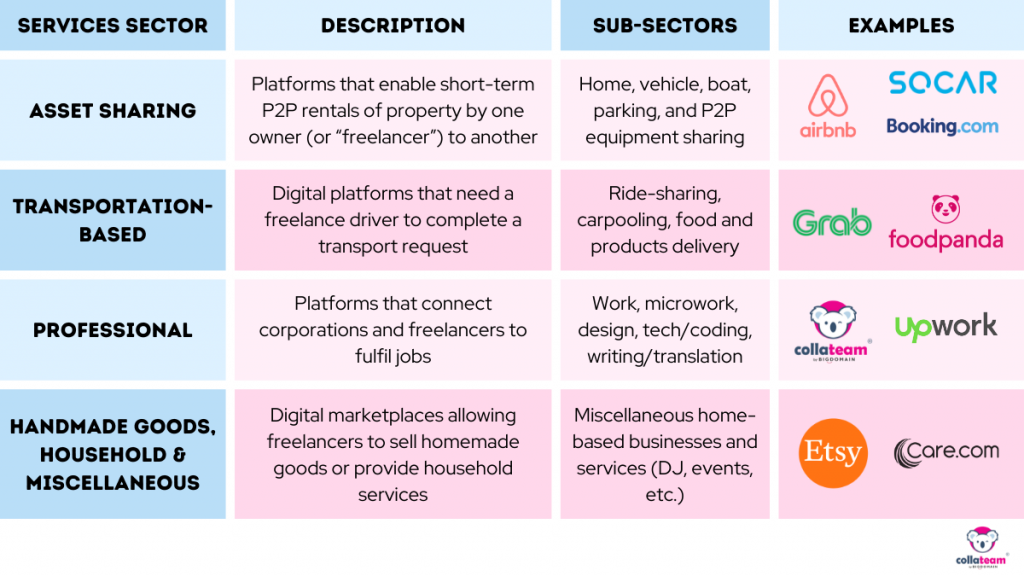
Below is the table for the services sector.
What Factors Encourage This To Happen?
- Artificial intelligence and other automated technologies have significantly impacted the job market. In some cases, digitization has reduced the number of available jobs as software replaces certain types of workers, such as customer service and content automation workers.
- Other factors have intensified the demand for businesses to hire more temporary employees. These include financial strains on organizations and the termination law, which requires a more flexible workforce that may be extended or reduced swiftly.
- Younger workers, such as millennials and Generation Z, are much more likely to shift employment more frequently than older, more traditional workers.
- Many businesses and organizations have felt the strain of maintaining their businesses during this pandemic. During the past two years, most businesses and services needed to shift to a new style to enable contactless delivery and services. As the cultural and business environments change, so does the role of this economy.
Job flexibility is more appealing, and potentially more necessary, than ever - FixApa
Benefits Of The Gig Economy
- Low Entry Barrier - It is very simple to enter this economy. Many jobs are concise and do not necessitate any qualifications or prior experience.
- Flexible - Able to achieve a better work-life balance by having the freedom to choose when, how long, and with whom to work. The workers have full control over selecting the choices and quotations of tasks and projects. Employers can choose the most qualified candidate for a specific project from a larger pool of candidates from the freelance platform. If the talent is found to be below satisfactory, there is no binding contract to retain the individual or obstacles to terminating them.
- Variety - In this economy, workers frequently perform multiple jobs for various clients instead of doing a similar position for one company only, which can help to avoid getting bored and keep work interesting and fresh. The worker is able to work in a different market to meet various industry demands.
- Independent - Most workers in this economy are self-employed. The worker, in other words, is their own boss. As a result, most workers are not required to attend meetings, conduct progress reviews, deal with office gossip and drama, or be under supervision. Their tasks will be completed based on their own schedule.
- Cost Saving - Employers reduce costs associated with training, incentives, and office space.
- Opportunity to Try New Things - It is beneficial for many people who have an entrepreneurial dream. They can continue to pursue their dreams without losing their primary source of income.
If you never try, you'll never know what you are capable of - John Barrow
Don't be afraid to try new things. You will realize there was a lot of potential you will discover in you - Skysoul
Pitfalls Of The Gig Economy
Of course, there are pitfalls in every profession. The following are six drawbacks to work in this gig economy.
- Not a "Real" Worker - According to the Employment Act 1955, workers in the gig economy are not included in the definition of workers. In 2020, the Deputy Minister of Human Resources stated that freelance workers are exempt from enjoying the same advantages as workers under Malaysian labour law due to the National Wage Consultative Council Act 2011 (Act 732) and the Minimum Wage Order (PGM) 2020. However, there is social security protection for self-employed individuals, including gig economy employees, such as food delivery and e-hailing services, if they pay contributions under the Self-employment Social Security Act 2017 (Act 789).
- Inconsistent Income - A flexible schedule entails a flexible salary. The earnings of a gig worker can vary significantly depending on the availability of the job. They are unable to control the number of jobs you receive in a month or a day. If no one offers a job, they will earn no money.
- Insecurity - It is not easy to get enough work to sustain a stable income.
- Lack of Benefits - Self-employed individuals are entirely responsible for their benefits, which means health insurance, retirement savings, medical fees, sick leave, Employees Provident Fund (EPF), etc., will be borne by themselves.
- Taxes and Expenses - Individuals who work for themselves are generally liable to pay taxes on money earned through side jobs, such as income taxes and Social Security. Since they are working for themselves, gig economy workers are responsible for self-purchasing and maintaining their tools and equipment, such as cars and computers.
- Poor Working Environment - Some people prefer to work in an office space to be motivated to work or reduce distractions from family. However, this is not a big deal as at BigCo; you can rent a co-working space for your daily work.

This job will be the right choice for you if you like to explore something new or earn supplemental income to your savings.
Let's Go Gig, Go Big with CollaTeam at https://colla.team/blog, stop wasting time & contact us at https://wapp.my/60189782066 to showcase your skill & boost your pocket money now!